tanzania times : Latest News and In-depth Analysis
Contact Us
Search

This series of images from NASA’s Hubble Space Telescope of the fragmenting comet C/2025 K1 (ATLAS) was taken over the course of three consecutive days – November. 8,9,and 10 last year (Picture: NASA/Cover Media)
NASA astronomers struck it lucky after the Hubble Space Telescope observed a comet in the act of disintegrating completely by chance.
The event was one that scientists believed they were unlikely to witness in real time.
And it was even more extraordinary as researchers had intended to observe a different comet,but were forced to change plans due to technical constraints.
The findings were published on Wednesday in the journal Icarus.
‘Sometimes the best science happens by accident,’ John Noonan,a research professor in the Department of Physics at Auburn University in Alabama,said.
‘This comet got observed because our original comet was not viewable due to some new technical constraints after we won our proposal. We had to find a new target – and right when we observed it,it happened to break apart,which is the slimmest of slim chances.”
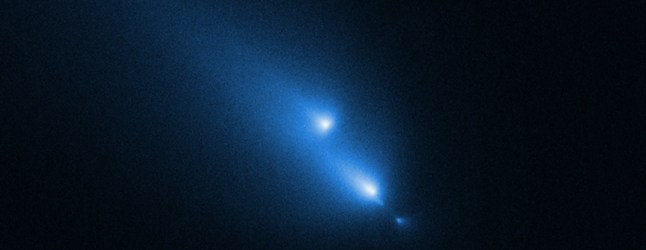
The object,known as Comet C/2025 K1 (ATLAS),can be seen progressively breaking apart in a sequence of images taken between November 8 and 10 last year.
Initially appearing as four bright objects,the largest fragment then splits further,with pieces drifting away from one another.
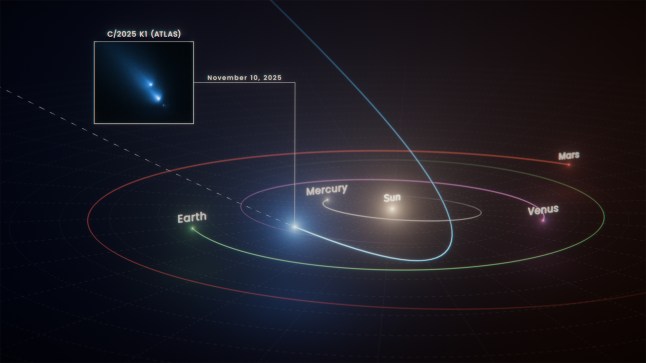
This diagram shows the path the comet took as it swung past the Sun and began its journey out of the solar system (Picture: NASA/Cover Media)
Noonan,a co-investigator on the study,said he did not realise the significance immediately.
‘While I was taking an initial look at the data,I saw that there were four comets in those images when we only proposed to look at one,’ he said. ‘So we knew this was something really,really special.’
Scientists have long attempted to capture such an event using Hubble,but the unpredictability of comet break-ups has made this difficult.
‘The irony is now we’re just studying a regular comet and it crumbles in front of our eyes,’ said principal investigator Dennis Bodewits,also of Auburn University.
‘Comets are leftovers of the era of solar system formation,so they’re made of “old stuff”—the primordial materials that made our solar system.
‘But they are not pristine – they’ve been heated; they’ve been irradiated by the Sun and by cosmic rays.
‘So,when looking at a comet’s composition,the question we always have is,“Is this a primitive property or is this due to evolution?’”
‘By cracking open a comet,you can see the ancient material that has not been processed.’
Hubble observed the comet splitting into at least four pieces,each surrounded by a glowing cloud of gas and dust known as a coma. While ground-based telescopes saw only faint bright patches,Hubble’s high resolution allowed scientists to distinguish individual fragments clearly.
The observations were made shortly after the comet passed its closest point to the Sun – known as perihelion – when heating and stress are at their greatest. Scientists believe the comet began breaking up about eight days before Hubble captured the images.
However,the team has identified a puzzling delay between the break-up and the brightening detected from Earth.
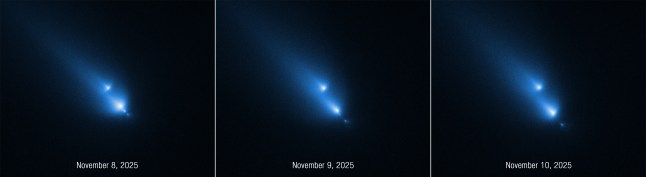
A series of images from NASA’s Hubble Space Telescope of the fragmenting comet (Picture: NASA/Cover Media)
One theory is that a layer of dust must first form over newly exposed ice before being blown away. Another possibility is that heat builds up beneath the surface before ejecting material into space.
‘Never before has Hubble caught a fragmenting comet this close to when it actually fell apart. Most of the time,it’s a few weeks to a month later. And in this case,we were able to see it just days after,’ said Noonan.
‘This is telling us something very important about the physics of what’s happening at the comet’s surface. We may be seeing the timescale it takes to form a substantial dust layer that can then be ejected by the gas.’
Early observations suggest the comet is chemically unusual,with significantly lower levels of carbon than typically seen. Further analysis using Hubble’s instruments is expected to reveal more about its composition and,potentially,the origins of the solar system.
Ebola responders in DRC have been attacked due to misinformation and false claims about the disease (Picture: AP Photo/Sebastien Kitsa Musayi)
Sep 30, 2026
The drone was found rigged with explosives near a Ukrainian cargo plane (Picture: Reuters) Russia has issued an ominous warning after Germany said the nation was behind an airport drone attack last m
Sep 7, 2026
At least three people have died in the avalanche of mud and water.
Sep 7, 2026
At least 22 people have died and 28 more were injured after a bus crashed near an Egyptian holiday hotspot.
Sep 3, 2026